
Image on Pinterest
If your certificate of deposit is maturing and the bank’s renewal offer is lower than what you earned previously, you are facing one of the most consequential quiet decisions in retirement planning. A fixed indexed annuity protects your principal from market losses while linking your growth potential to a market index such as the S&P 500, and for retirees comparing their options in 2026, it deserves a careful look alongside that renewal slip.
This guide covers how an indexed annuity works, how it compares to a CD across growth potential, safety, tax treatment, and liquidity, and what questions to ask before you commit your money anywhere. Dr. Taiwo Akindahunsi and the team at T-Bridge Finance LLC built this resource to help you make that decision with complete information and without pressure. You will find a plain-language breakdown of both products, a side-by-side comparison of how each one credits your growth, and a practical checklist for the decision point that a maturing CD creates.
RELATED BLOGPOST
FIXED INDEXED ANNUITIES Vs THE STOCK MARKET: WHAT RETIREES DESPERATELY Need To Know In Q3
BEST RETIREMENT INCOME STRATEGIES: ANNUITIES AND TAX PORTFOLIOS
HOW TO ROLLOVER YOUR 401K TO A FIXED INDEX ANNUITY: PROS, CONS & 2026 RULES
BACKDOOR ROTH CONVERSION: A STEP-BY-STEP GUIDE FOR HIGH EARNERS
What Is a Fixed Indexed Annuity and Why Are Retirees Comparing It to CDs Right Now?
A fixed indexed annuity, also called an FIA or simply an indexed annuity, is a contract issued by a licensed insurance company in which your money grows based on the performance of a market index while a contractual floor of zero percent guarantees that you can never lose principal to market declines. If the S&P 500 gains 14 percent during a crediting period and your contract carries a cap rate of 9 percent, your account is credited 9 percent.
If the S&P 500 falls 20 percent, your credited interest for that period is zero and your account value stays exactly where it was the day the crediting period began. Every gain already credited to your account is locked in permanently and cannot be reversed by future downturns.
The term “equity indexed annuity” refers to the same product. The financial industry adopted “fixed indexed annuity” as the preferred terminology following guidance from the National Association of Insurance Commissioners (NAIC), but all three names, equity indexed annuity, indexed annuity, and fixed indexed annuity, describe the same structure: market-linked growth potential with a built-in floor that prevents negative credits.
Retirees are actively comparing indexed annuities to CDs right now because the rate environment is shifting in a specific direction. According to Annuity.org, S&P 500 cap rates from top-rated carriers currently range from 8 percent to 12 percent as of mid-2026, which is a meaningful improvement over the suppressed cap rate environment of 2020 and 2021. At the same time, bank CD renewal rates have been declining as the Federal Reserve signals potential rate reductions ahead, which means that a retiree renewing a 5-year CD today is likely being offered meaningfully less than what they earned on their prior term. That combination creates an obvious and legitimate reason to put the two products side by side.
T-Bridge Finance LLC and Dr. Taiwo Akindahunsi work with pre-retirees and retirees across the United States to evaluate exactly this question, and the team’s consistent observation is that most retirees have never seen a clear, honest comparison that explains both products on their own terms without an agenda attached to the outcome.

Image on Pinterest
What Is a CD and What Has Made It the Default Safe-Money Vehicle for American Retirees?
A certificate of deposit, commonly called a CD, is a time deposit offered by FDIC-member banks and NCUA-member credit unions that pays a fixed interest rate for a defined term, typically ranging from three months to five years. When you open a CD, you agree to leave your principal untouched until the maturity date in exchange for the institution’s guaranteed rate. If you withdraw before maturity, the bank charges an early withdrawal penalty that typically ranges from 90 to 180 days of earned interest depending on the term and institution.
CDs have earned their status as the default safe-money option for two reasons: they are federally insured by the FDIC up to $250,000 per depositor per bank, and they require nothing from you to earn the stated rate. You do not need to understand index crediting methods, cap rates, or participation rates. You simply deposit your money and collect a predictable return. For retirees who lived through the 2008 financial crisis or the 2020 market crash, that simplicity and that federal guarantee carry real psychological weight that no financial comparison should dismiss.
The problem that brings retirees into a serious conversation about a fixed indexed annuity is not the safety of the CD itself but what happens when the CD matures in a lower-rate environment. According to Annuity.org, the best 5-year bank CDs as of July 2026 are paying approximately 4.15 percent, which is meaningfully lower than what retirees who locked in rates during 2022 and 2023 were earning. A retiree receiving a renewal offer 100 to 150 basis points below their prior rate faces a genuine income gap that deserves a thoughtful response, not a passive auto-renewal.
What Happens When Your CD Matures and the New Rate Disappoints You?
When a CD matures, most banks give account holders a narrow response window, often just 7 to 10 days, to make a decision. If you do not actively respond, most institutions automatically roll your full balance into a new CD at whatever current rate they are offering, which may be substantially lower than your prior rate. That passive renewal is how retirees who locked in 5.25 percent two years ago end up in a new one-year term at 3.9 percent without ever having consciously agreed to a lower return.
The critical observation that Dr. Taiwo Akindahunsi makes with clients at T-Bridge Finance LLC is this: a maturing CD is not an administrative formality to manage and forget. It is one of the rare moments in retirement when you hold full liquidity, full flexibility, and a genuine opportunity to determine whether your current product still matches your actual financial goals. Treating it as a renewal task rather than a planning opportunity is the single most common and most costly passive financial decision retirees make.
A concrete example helps frame why this matters at a practical level. Consider a 67-year-old retiree, with $175,000 in a 5-year CD that is now maturing. Her original rate was 5.1 percent and the bank is offering to renew at 3.85 percent. On $175,000 over five years, that rate difference represents more than $11,000 in lost interest at face value, and because the IRS requires CD interest to be reported as ordinary income in the year it is credited regardless of whether she withdraws anything, she is paying federal income taxes on that interest every single year.
A fixed indexed annuity with a 9 percent cap rate, a 0 percent floor, and tax-deferred growth does not guarantee it will outperform the CD in every individual year, but it gives her the structural opportunity to do so while never exposing her $175,000 to a market loss.
Indexed Annuity vs CD: How the Core Mechanics Actually Differ
The most consequential mistake retirees make in this comparison is treating a fixed indexed annuity as a simple interest-rate product like a CD or a savings bond. It is structurally different in ways that matter, and understanding those differences before comparing the two is the only way to evaluate them honestly.
How a Fixed Indexed Annuity Credits Your Growth
A fixed indexed annuity does not invest your money directly in the stock market. The insurance carrier holds your premium in its general account and purchases index options to generate the market-linked credits it contractually promises you. At each contract anniversary, the carrier measures the index value against the value at the beginning of the crediting period and applies one of three crediting methods to determine how much interest flows into your account.
The most common method is the cap rate. If the S&P 500 gains more than the cap, you earn the cap rate. If the index gains less than the cap, you earn the actual index gain. If the index falls, you earn zero percent for that period. Cap rates from top-rated carriers as of mid-2026 range from 8 percent to 12 percent for S&P 500 annual point-to-point strategies.
The second method is the participation rate, which credits a stated percentage of whatever the index gains without imposing a ceiling. Participation rates on fixed indexed annuities typically range from 50 percent to over 100 percent depending on the carrier, the index chosen, and the surrender charge period selected. A 90 percent participation rate on a 10 percent index gain credits 9 percent to your account.
The third method, called the spread, subtracts a fixed percentage from the index gain and credits the remainder, so a 3 percent spread applied to an 8 percent index gain credits 5 percent.
The protection embedded in every one of these methods is the same: if the tracked index finishes the crediting period with a loss, your credited interest is zero, not negative, and your account balance on the first day of the new crediting period equals your balance on the last day of the prior period. All previously credited gains are permanently locked in. That lock-in feature is what makes a fixed indexed annuity a categorically different kind of safe-money product from a CD, because a CD can match that principal protection but cannot match the upside structure.
One important nuance that Dr. Taiwo Akindahunsi consistently raises with clients at T-Bridge Finance LLC is that cap rates on a fixed indexed annuity are not permanently locked in the way a CD rate is. Carriers reset cap rates at each contract anniversary based on current Treasury yields and their own investment performance. Contracts include a contractually guaranteed minimum cap, but that minimum can be as low as 1 percent in some carrier offerings. Before purchasing any indexed annuity product, retirees should request the carrier’s cap rate reset history over the prior five to seven years to understand how the carrier has behaved toward policyholders during low-rate periods.
How a CD Locks In Your Rate and What Happens When the Term Ends
A CD operates on a fundamentally different model. When you open a CD, the bank fixes your interest rate for the entire term and there is nothing in the product that allows it to outperform that stated APY. A 4.15 percent 5-year CD will credit 4.15 percent per year for five years and not a single basis point more, regardless of what interest rates do during that period. That certainty is simultaneously the product’s greatest strength and its defining limitation.
What you gain with a CD is predictability that a fixed indexed annuity cannot replicate. You know exactly how much interest you will earn, exactly when you will have full access to your principal, and exactly what your 1099-INT will show each year. The annual tax bill is worth understanding in concrete terms: the IRS requires CD interest to be reported as ordinary income in the year it is earned under IRS Publication 550, even if you have not touched the money. That means a retiree earning $7,000 in CD interest during 2026 owes income tax on that $7,000 on this year’s federal return, whether or not a single dollar has left the bank.
The maturity event itself is where CD holders feel the most structural pressure compared to their indexed annuity counterparts. Banks give a narrow decision window, and retirees who do not engage with it actively end up in a new contract at whatever current rates allow. A fixed indexed annuity at the end of its surrender period offers the contract owner meaningfully more flexibility: you can take a lump sum, roll into a new annuity contract, convert the accumulated value into a guaranteed lifetime income stream, or execute a tax-free 1035 exchange into a different annuity product, all without triggering a tax event.
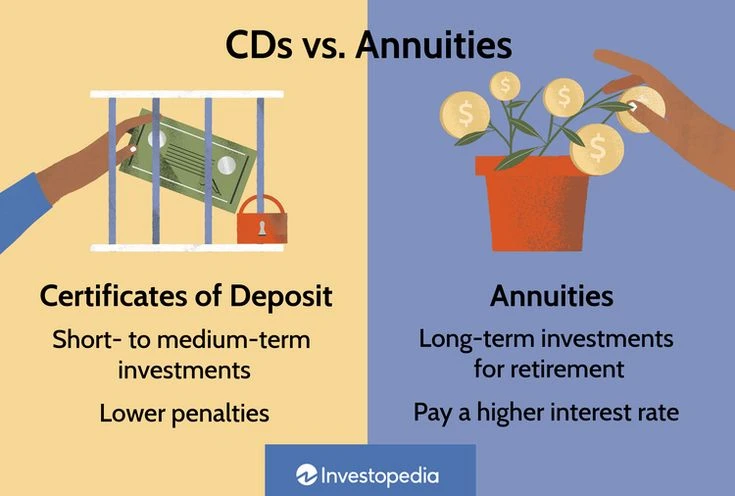
Image on Pinterest
How Is an Indexed Annuity Taxed Compared to a CD?
The tax treatment of these two products is one of the most practically significant differences between them and one that many retirees do not fully understand until they sit across the table from a licensed advisor and run the actual numbers for their bracket.
A fixed indexed annuity grows tax-deferred, which means you owe no income tax on credited interest until you take a withdrawal or begin receiving income payments. A CD generates a 1099-INT every single year, and the interest it earns in a given year is taxable in that year regardless of whether you withdraw any funds.
For a retiree in the 22 percent federal tax bracket holding $150,000 in a CD at 4.15 percent, approximately $6,225 in interest will appear on a 1099-INT for 2026, resulting in roughly $1,370 in federal tax owed on money that may not have left the bank. Over five years, that annual tax drag compounds into a meaningful reduction in effective yield that the stated APY does not reveal.
A non-qualified fixed indexed annuity, meaning one funded with after-tax dollars rather than 401k or IRA money, defers all of that tax until withdrawal. Under IRS Publication 575, annuity earnings in a non-qualified contract are taxed as ordinary income when distributed, using a last-in, first-out (LIFO) method in which earnings come out before principal. For retirees who expect to move into a lower tax bracket at age 73 or 75 than they occupy today, that deferral is not just a timing convenience but a compounding wealth advantage that the CD’s annual tax bill systematically erodes.
T-Bridge Finance LLC and Dr. Taiwo Akindahunsi always recommend that clients model their specific tax scenario with a licensed tax professional before choosing between a fixed indexed annuity and a CD renewal, because the magnitude of the tax deferral benefit depends entirely on where your marginal bracket is headed, not just where it stands today.
Is a Fixed Indexed Annuity as Safe as an FDIC-Insured CD?
Both products are designed to protect principal, but they accomplish that through different mechanisms, and the distinction matters for how you think about each type of risk.
A CD is backed by the full faith and credit of the federal government through the FDIC, which insures deposits up to $250,000 per depositor per insured bank and has never failed to honor a covered claim since its establishment in 1933. That federal guarantee is unique to bank deposits and represents the clearest form of principal protection available in the United States financial system.
A fixed indexed annuity is not FDIC-insured but is protected through two separate mechanisms. The first is the financial strength of the issuing insurance carrier, evaluated by independent rating agencies, where a rating of A minus or higher is the standard minimum that T-Bridge Finance LLC recommends for client deployments.
The second is your state’s insurance guaranty association, which serves as a backstop if a carrier becomes insolvent. The National Organization of Life and Health Insurance Guaranty Associations (NOLHGA) coordinates these state-level protections, which typically cover up to $250,000 per carrier per contract holder in most states. Retirees holding larger balances in indexed annuities can spread their funds across two or three highly rated carriers to multiply that coverage effectively across the same NOLHGA network.
Neither protection is categorically inferior to the other for the vast majority of American retirees. The FDIC and state guaranty systems have each handled their respective obligations responsibly. What matters is that you know which system covers your specific product and that you understand the limits on coverage so you structure your balances accordingly.
Can You Roll a Maturing CD or a 401k Into an Indexed Annuity Without Paying Taxes?
For a maturing CD held in a non-qualified (taxable) account, moving the proceeds into a non-qualified indexed annuity does not trigger a taxable event, because you are reinvesting after-tax money into a new insurance contract. The transaction is not a rollover in the technical IRS sense and has no tax consequence at the time of the move. The tax-deferred treatment of the indexed annuity’s future growth begins from the day the contract is funded.
A 401k rollover into a qualified indexed annuity is handled differently and must be structured correctly to avoid a significant tax liability. A direct (trustee-to-trustee) rollover from a 401k plan to a qualified indexed annuity avoids both the 10 percent early withdrawal penalty that the IRS applies to distributions before age 59 and a half and the 20 percent mandatory withholding that applies to indirect rollovers in which funds pass through your personal bank account first.
The qualified indexed annuity inside the IRA wrapper receives the same tax-deferred treatment the funds carried in the 401k, with the added structural benefits of principal protection through the 0 percent floor and optional income riders that most 401k fund menus do not offer.
The objection that financially experienced retirees raise here is that putting an annuity inside a tax-deferred account is redundant because the IRA already provides tax deferral. Dr. Taiwo Akindahunsi and the T-Bridge Finance LLC team address this point directly with clients: the value of a qualified indexed annuity inside an IRA is not the tax deferral, which is true and already provided by the IRA wrapper, but the principal protection floor, the market-linked growth potential above what a CD inside an IRA can offer, and specifically the guaranteed lifetime withdrawal benefit (GLWB) rider options that can convert the accumulated balance into a guaranteed income stream for life.
No CD, whether held inside an IRA or outside one, can offer that last feature.
What Should You Ask Before Moving Your Maturing CD Into a Fixed Indexed Annuity?
The decision between a fixed indexed annuity and a CD renewal is not one that generalizes cleanly across all retirees, and the right answer depends on facts that are specific to your life, not to the products themselves. Before committing to either option, there are five questions every retiree should be able to answer clearly.
First, how much of this money do you need access to within the next 12 months? A fixed indexed annuity typically allows penalty-free withdrawals of up to 10 percent of account value per contract year after the first year, but withdrawals beyond that during the surrender period incur declining charges that run 7 to 10 years depending on the product. If you need full liquidity within a short window, a CD may be the more appropriate vehicle for that portion of your savings.
Second, what does your income picture already look like? If Social Security, a pension, or other guaranteed income sources already cover your essential expenses, your indexed annuity purchase may function best as a long-term growth vehicle rather than an immediate income tool, and that changes how you should evaluate cap rates versus income rider options.
Third, what is the AM Best rating of the carrier you are considering? A minimum of A minus is the standard that T-Bridge Finance LLC recommends for any indexed annuity carrier receiving significant retirement balances, and the team at T-Bridge prefers carriers rated A or better across the full evaluation history.
Fourth, what is the carrier’s cap rate reset history over the past five to seven years? A carrier who maintained competitive cap rates through the low-rate environment of 2020 and 2021 is demonstrating policyholder commitment that a newly launched carrier cannot yet demonstrate.
Fifth, are you working with a licensed financial advisor who is reviewing the indexed annuity against your complete financial picture, or are you working with a product salesperson whose compensation depends on the outcome? T-Bridge Finance LLC provides comprehensive financial advisory services to retirees and pre-retirees across the United States, and Dr. Taiwo Akindahunsi’s framework is built on the principle that you should never commit to an indexed annuity or any other retirement product without a full-picture review first.
What T-Bridge Finance LLC’s Advisory Approach Concludes About This Decision
A fixed indexed annuity is not automatically better than renewing a CD, it simply serves different retiree needs. Annuities excel at protecting principal from market losses, offering market-linked growth potential, providing tax deferral, and enabling guaranteed lifetime income. CDs remain ideal for full liquidity at a known date, smaller balances, or when FDIC insurance is essential for peace of mind. Many clients successfully hold both products in balanced proportions. The real question at CD maturity isn’t short-term yield, but which vehicle best supports your decade-long goals.
Ready to model your options without pressure or bias? Contact Dr. Taiwo Akindahunsi and the team at T-Bridge Finance LLC today for a personalized, no-obligation review.
About the Author
Maxwell is a financial content strategist at T-Bridge Finance LLC, a financial services firm based in Bowie, Maryland. All articles published on this blog are reviewed by the licensed PROFESSIONALS at T-Bridge Finance LLC before publication to ensure accuracy and compliance with current insurance and financial guidelines. T-Bridge Finance LLC holds active insurance licenses and serves families across the United States with life insurance, estate planning, college funding, and tax-advantaged wealth strategies. schedule a free consultation.
FAQ
1. What is the difference between an equity indexed annuity and a fixed indexed annuity?
They are the same product. The industry originally used “equity indexed annuity” as the product name and later adopted “fixed indexed annuity” and “indexed annuity” as the preferred terminology following regulatory guidance from the NAIC. All three names describe a contract that links credited interest to a market index while guaranteeing a 0 percent floor that prevents negative credits to your account balance.
2. Can you lose money in a fixed indexed annuity if the stock market crashes?
No. A fixed indexed annuity guarantees a 0 percent floor on index-linked interest credits, which means that if the tracked index falls during a crediting period, your credited interest for that period is zero and your account balance does not decrease. Gains previously credited to your account are permanently locked in and cannot be reduced by future market losses, regardless of how severe the downturn becomes.
3. Is an indexed annuity FDIC-insured the same way a CD is?
No. A CD is federally insured through the FDIC up to $250,000 per depositor per bank. A fixed indexed annuity is not FDIC-insured but is backed by the claims-paying ability of the issuing insurance carrier and protected by your state’s insurance guaranty association, which typically covers up to $250,000 per carrier in most states through the NOLHGA network. Retirees with balances exceeding that threshold can spread funds across multiple highly rated carriers to maximize guaranty coverage.
4. How does a fixed indexed annuity compare to a CD in a falling interest rate environment?
When interest rates fall, CD renewal rates decline quickly because they track short-term rate movements directly. Fixed indexed annuity cap rates also respond to rate changes but historically adjust more gradually. According to Annuity.org, top-rated 5-year MYGAs are currently paying approximately 6.30 percent as of July 2026, compared to approximately 4.15 percent for the best 5-year bank CDs, and indexed annuity cap rates on S&P 500 strategies range from 8 to 12 percent from top-rated carriers. The indexed annuity does not guarantee that it will outperform the CD in every individual year, but it offers structural growth potential that a CD renewal cannot match in a favorable index year.
5. Can I roll over a 401k into a fixed indexed annuity?
Yes. A 401k can be transferred into a qualified fixed indexed annuity through a direct trustee-to-trustee rollover without triggering income taxes or the 20 percent mandatory withholding that applies to indirect rollovers. The resulting qualified annuity provides principal protection, potential market-linked growth, and optional income riders that can convert your accumulated balance into a guaranteed lifetime income stream.
Disclaimer: The information in this article is for educational purposes only and does not constitute financial, legal, or insurance advice. Life insurance and financial products vary by carrier, state of residence, age, health profile, and individual circumstances. Past index performance does not guarantee future results. Cash value illustrations referenced in this article are hypothetical projections and not a guarantee of policy performance. T-Bridge Finance LLC is a licensed financial services firm operating in the United States. Please consult a licensed financial advisor or insurance professional before making any insurance or financial planning decisions. To speak with our team, contact us here.