Image on Pinterest
Every July, the United States observes Disability Pride Month, a national recognition anchored to the signing of the Americans with Disabilities Act on July 26, 1990, and in 2026, the theme is “The World Works Better With Us.” The ADA is one of the most consequential civil rights laws in American history, and it prohibits discrimination against people with disabilities across employment, public spaces, transportation, and government services.
What it does not do, and what millions of working adults wrongly assume it does, is replace your income if a disability keeps you from working. Disability Pride Month is both a genuine civil rights celebration and, for anyone who understands the financial stakes, one of the most actionable annual reminders to review your disability income protection.
This guide covers the full story of Disability Pride Month in 2026: its history, the 2026 theme, what each color on the disability pride month flag represents, how Disability Pride Month in July differs from Disability Awareness Month in October, and most importantly, how the ADA’s real legal scope connects to a financial gap that affects every working adult regardless of where they live. Understanding exactly what the ADA does and does not protect is the first practical step toward covering the gap it leaves open.
RELATED BLOGPOST
Disabled? Mortgage Protection Insurance Can Keep Your Family in Their Home
Short Term vs Long Term Disability Insurance: Which One Do Workers Actually Need?
Long Term Care Insurance and Life Insurance: 2026 Guide
Disability Insurance: Protecting Your Income from the Unexpected

Image on Pinterest
What Is Disability Pride Month?
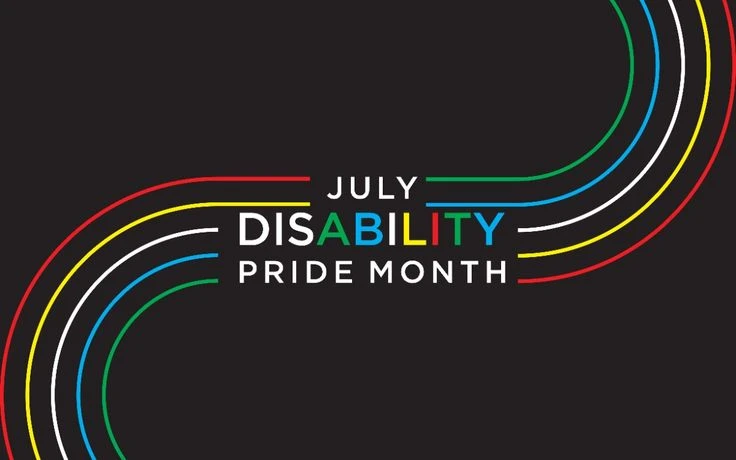
Disability Pride Month is a national observance held every July to celebrate the identity, culture, and contributions of people with disabilities, to honor the legal milestone represented by the Americans with Disabilities Act (ADA), and to push back on ableism, exclusion, and the systemic barriers that continue to limit opportunity and access. The 2026 Disability Pride Month theme, “The World Works Better With Us,” reflects a core argument of the disability rights movement: that inclusion is not charity, it is a structural improvement that benefits everyone.
The phrase “disability pride month” may be unfamiliar to some, but the movement carries deep roots. Disability Pride initially started as a day of celebration in 1990, the same year the ADA was signed into law, when Boston held the first Disability Pride Day. The first official Disability Pride Month was observed in July 2015, marking the 25th anniversary of the ADA, and cities across the country have celebrated it annually since then with parades, disability arts showcases, and community gatherings.
Disability Pride Month is not an awareness campaign in the passive sense, it is a civil rights celebration, and that distinction matters. Awareness asks people to notice disability, but pride asks people to honor it as a natural dimension of human diversity and to build systems that fully include disabled people rather than merely accommodating them at the margins.
Why Is Disability Pride Month Celebrated in July?
Disability Pride Month falls in July because the ADA was signed into law on July 26, 1990, by President George H.W. Bush, and it provides civil rights protections to individuals with physical and mental disabilities, guaranteeing them equal opportunity in public accommodations, employment, transportation, state and local government services, and telecommunications.
As of 2024, one in four Americans live with a disability. That figure alone explains why Disability Pride Month has grown into a nationally significant cultural moment, and why the financial planning conversation it opens up is relevant to a far broader population than most people assume. Disability is not a rare condition that happens to other people. It is a statistical reality of working life in the United States, and every working adult who depends on their income to meet their financial obligations has a stake in understanding what happens if that income stops.
For T-Bridge Finance LLC and its clients, July 26 functions as an annual marker: a built-in, nationally recognized moment to ask one practical question: if your health changed tomorrow, how long could your household sustain itself on what your current disability coverage actually pays?
What Does the Disability Pride Month Flag Mean?
The disability pride month flag is a visual representation of the full range of the disability community, and understanding its design is part of engaging with Disability Pride Month meaningfully. The Disability Pride Flag was created by Ann Magill, a writer with cerebral palsy, and was later updated based on community feedback.
The flag features a black background, which represents the mourning and rage associated with the historical violence and systemic neglect directed at people with disabilities. Crossing the black field are five diagonal colored stripes, each representing a different aspect of the disability experience. Red represents physical disabilities, gold represents neurodiversity, white represents invisible and undiagnosed disabilities, blue represents psychiatric and emotional disabilities, and green represents sensory disabilities. (libguides)
The diagonal orientation of the stripes was a deliberate accessibility decision. The original flag used horizontal stripes, but the redesign by Magill shifted to diagonals specifically to make the flag usable by people with photosensitive conditions, including certain forms of epilepsy and visual processing disorders. That design choice, making a disability pride symbol more accessible to people with disabilities, reflects the broader ethic of the month itself: inclusion must be structural, not merely symbolic.
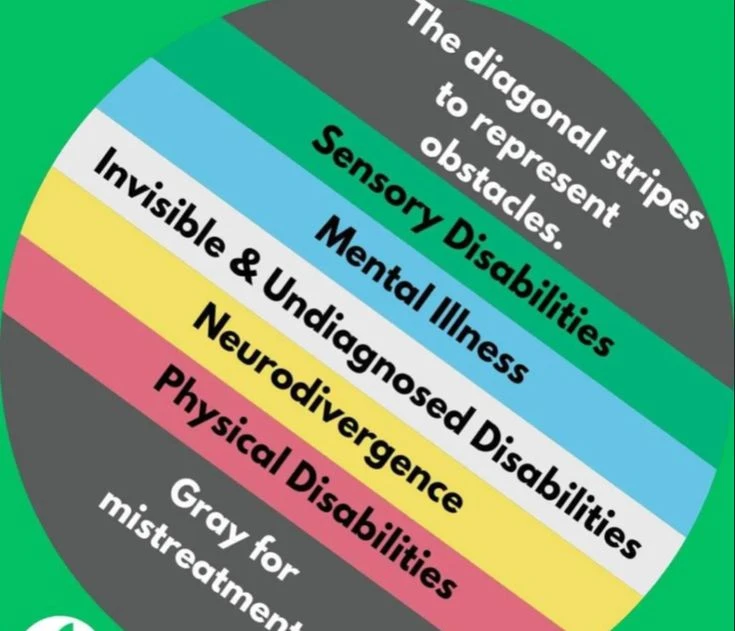
Image on Pinterest
What Is the Difference Between July Disability Pride Month and October Disability Awareness Month?
This is one of the most consistently misunderstood aspects of the disability calendar, and the confusion is worth addressing directly because the two observances serve genuinely distinct purposes.
July Disability Pride Month: Civil Rights, Identity, and Cultural Celebration
July Disability Pride Month centers on celebrating disability identity and honoring the legal gains the disability community fought for across decades of advocacy, and the tone is affirmative and cultural. Disability Pride Month events include parades, disability arts showcases, advocacy forums, and community gatherings oriented around the question: how do we honor and fully include people with disabilities as equal participants in every dimension of public life?
The financial planning parallel here is worth naming directly. Just as Disability Pride Month challenges the idea that disability is a deficit to be managed rather than a dimension of human experience to be included, responsible disability income planning challenges the idea that financial vulnerability is a distant, abstract risk rather than a present exposure that deserves active attention. Both conversations require you to look squarely at something most people prefer to defer.
October National Disability Employment Awareness Month: Workforce Policy and Employer Practices
National Disability Employment Awareness Month (NDEAM), observed every October, was established by Congress in 1988 and is administered by the Department of Labor’s Office of Disability Employment Policy. Its focus is narrower and more institutional: how employers recruit, retain, and support workers with disabilities, and how federal and state policy can remove employment barriers.
NDEAM is primarily directed at employers and human resources professionals, while Disability Pride Month speaks to the broader public. Both carry implications for how working adults should think about income protection, but if you are reading this in July, Disability Pride Month is your timely prompt and the ADA anniversary on July 26 is a natural deadline for acting on it.
What Does the ADA Actually Cover — and What Does It Not Cover?
Understanding what the Americans with Disabilities Act does and does not protect is the most important piece of practical knowledge this article can offer. The ADA is a civil rights law, it is not an income protection program, and conflating the two is one of the most financially costly assumptions a working adult can make.
The ADA prohibits discrimination on the basis of disability across five major domains.
Title I covers employment discrimination by employers with 15 or more employees.
Title II covers state and local government services and programs.
Title III covers public accommodations, which includes restaurants, hotels, theaters, and retail establishments.
Title IV covers telecommunications services.
Title V contains miscellaneous provisions including anti-retaliation protections for people who assert their ADA rights.
The ADA also requires employers to provide reasonable accommodations to qualified employees with disabilities, meaning adjustments or modifications that allow a person to perform their essential job functions without imposing undue hardship on the employer.
What the ADA does not require, under any of its titles, is that your employer continue paying your salary if you are medically unable to work. The history of disability rights in the United States, including in the 35 years since the passage of the ADA, has made it clear that the ADA alone is not enough to fulfill the promise of equal access, independent living, and full participation for those with disabilities.
The Family and Medical Leave Act offers eligible employees up to 12 weeks of job-protected leave per year for qualifying medical conditions, but FMLA leave is generally unpaid. It keeps your position available when you return, it does not keep your mortgage, utilities, or child care paid while you are out.
This is the gap that disability income insurance exists to fill, and it is the gap that Disability Pride Month, if used as a financial planning prompt, can motivate you to finally close.
The Income Gap the ADA Doesn’t Fill
What T-Bridge Finance LLC consistently observes among high-income professionals and small business owners is a pattern that plays out quietly until it becomes urgent. Clients arrive for planning consultations knowing they have “some disability coverage” through their employer, but without having ever looked at three critical figures: the elimination period before benefits begin, the income replacement ratio the policy actually pays, and the maximum duration the benefit will last.
These numbers are not abstract. Just under one in four of today’s 20-year-olds can expect to be out of work for at least a year because of a disabling condition before reaching the normal retirement age, according to the Social Security Administration.
According to the Council for Disability Awareness, the average long-term disability lasts 31.2 months, or just under three years. Most employer-sponsored short-term disability plans are exhausted within 90 to 180 days, which means there is a gap of more than two years during which a worker without supplemental individual coverage receives nothing beyond whatever Social Security Disability Insurance benefit they eventually qualify for after a months-long application process.
As of February 2026, the average SSDI benefit for a disabled worker is approximately $1,630 a month, which equates to $19,560 annually, an amount that falls below the federal poverty guideline for a two-person household. For a professional earning $80,000, $120,000, or more annually, SSDI alone does not come close to sustaining a household’s obligations.
Dr. Taiwo Akindahunsi, founder of T-Bridge Finance LLC, works specifically with clients who sit at the intersection of high income and high financial exposure: professionals, business owners, and diaspora investors who have built significant financial obligations and would face the steepest consequences from a prolonged income disruption. The disability income planning work that T-Bridge Finance LLC does is not about selling a product, it is about making the gap visible before a medical event makes it unavoidable.
Short-Term Disability Insurance vs. Long-Term Disability Insurance: Understanding the Difference
These two products are designed to work together as a continuous system of income protection, not to substitute for one another, and the confusion between them is one of the most common blind spots in personal financial planning. Both are directly relevant to what Disability Pride Month should prompt you to evaluate.
Short-Term Disability Insurance: Bridging the Immediate Window
Short-term disability insurance typically activates after a brief elimination period, often seven to fourteen days, and pays a percentage of your income, generally 60 to 70 percent, for a benefit period of three to six months. Many employers offer short-term disability as part of their group benefits package, and in some cases the employer covers the full premium cost.
The structural limitation of short-term disability coverage is that it was designed for temporary conditions: a surgical recovery, a pregnancy-related leave, or an acute illness from which the worker is expected to return within a few months. It is not designed for conditions that remove someone from the workforce for a year or more, and it was never intended to serve as a complete disability solution.
You can think of short-term disability insurance as a financial bridge from the day a disability begins to the point where long-term coverage begins to pay, and then confirm that your bridge is long enough to actually reach the other side.
Long-Term Disability Insurance: Coverage for the Extended Absence
Long-term disability insurance has a longer elimination period, most commonly 90 to 180 days, meaning a policyholder must remain disabled for that duration before the benefit activates. Once it activates, however, long-term disability coverage can replace a portion of income for two years, five years, ten years, or through age 65, depending on the policy’s benefit period.
From 2014 to 2023, only 30 percent of SSDI claimants had their applications approved, around 20 percent at the initial application stage and the remainder after a reconsideration or appeals process. It generally takes three to five months from the time of application for SSDI benefits to receive an initial decision, and as of February 2026, there were over 340,000 pending SSDI appeals hearings with an average processing time of almost 9 months. This approval timeline underscores why individual long-term disability coverage, which activates based on your policy’s medical criteria rather than a federal approval process, is such a critical financial tool for anyone whose household depends on their income.
At least 51 million working adults in the United States are without disability insurance other than the basic coverage available through Social Security. For the clients T-Bridge Finance LLC works with, including diaspora investors and professionals with household incomes significantly above the median, supplemental individual long-term disability policies are frequently necessary to close the gap between what a group employer plan pays and what their actual monthly financial obligations require.
How Much Income Would You Actually Lose if You Became Disabled Tomorrow?
This is the question Disability Pride Month should prompt every working adult to sit with. The answer is not difficult to calculate, but it requires pulling four specific pieces of information: your monthly gross income, your employer’s disability benefit amount, the elimination period before that benefit begins, and the maximum duration your employer’s plan will pay.
A simple starting benchmark: take your monthly gross income and multiply it by 0.60. That figure represents the rough minimum your disability coverage should pay to sustain your essential obligations. If your employer plan pays less than that, or if your elimination period creates a gap your liquid savings cannot bridge, you have identified a shortfall that merits immediate attention.
According to the SSA’s most recent disability program statistics, the average monthly benefit received by disabled workers in December 2024 was $1,580.79. (Center on Budget and Policy Priorities) A household running on $6,000, $8,000, or $10,000 per month cannot sustain itself on that figure, and the SSDI application and approval timeline means that benefit would not arrive for months even if it were approved immediately.
T-Bridge Finance LLC helps clients convert this calculation from an abstract exercise into a specific action plan, modeling the gap against each client’s actual salary, obligations, and existing coverage before recommending any supplemental product.
How to Review Your Disability Income Coverage During Disability Pride Month
A disability coverage review does not require a financial background or hours of research, it requires four documents and approximately 30 minutes of focused attention. T-Bridge Finance LLC walks clients through the same five-step process for every disability income review.
The first step is to pull your employer’s group disability plan summary, which should specify the benefit amount expressed as a percentage of salary, the elimination period, and the maximum benefit duration.
The second step is to identify any individual disability policies you hold outside of your employer plan and note those same three figures.
The third step is to review your most recent pay stub and calculate your actual monthly gross income.
The fourth step is to compare your total potential disability income against your fixed monthly obligations: housing costs, utilities, insurance premiums, loan payments, and dependent care.
The fifth step is to bring those numbers to a disability income specialist who can show you what your coverage gap looks like in dollar terms and what closing it would cost.
Disability Pride Month gives you a natural annual prompt for this five-step process. The ADA anniversary on July 26 gives you a specific deadline. The combination of those two things makes the last week of July one of the highest-leverage windows of the year for protecting your financial future.
Disability Pride Month 2026 and Your Financial Future: The Connection Worth Making
Disability Pride Month is a genuine and meaningful civil rights observance, and it deserves to be treated as one. At the same time, the ADA anniversary that anchors the month is an annual reminder of a legal reality with a direct financial implication: the law that protects your right to equal treatment in the workplace does not protect your income if you become unable to perform your work.
Advocates in the disability community view the ADA as a foundational victory but not a complete one. That same perspective applies to financial planning. Employer benefits and Social Security provide a foundation, but for most working adults, that foundation is not sufficient to sustain a household through a disability lasting two to three years. The gap between what exists and what you actually need is where T-Bridge Finance LLC does its most important work.
Dr. Taiwo Akindahunsi and the T-Bridge Finance LLC team exist to help clients see that gap clearly and close it purposefully, not because disability is inevitable, but because the financial consequences of being unprepared are entirely preventable.
If this is the first time you have thought carefully about whether your disability coverage is actually sufficient, Disability Pride Month is a meaningful starting point. If you have meant to revisit your coverage for months and kept deferring it, July 26 is your deadline.
Take the Next Step Before the ADA Anniversary on July 26
Disability Pride Month gives you the cultural context and the historical weight. The ADA anniversary on July 26 gives you the deadline. What sits between those two anchors is a 30-minute financial conversation that most working adults have been putting off and that T-Bridge Finance LLC is specifically equipped to guide.
Reach out to T-Bridge Finance LLC to schedule a complimentary disability income review with Dr. Taiwo Akindahunsi. Disability Pride Month is a reminder that financial protection is not a privilege reserved for the wealthy or the cautious. It is a plan, and a plan is something you can begin building today.
About the Author
Maxwell is a financial content strategist at T-Bridge Finance LLC, a financial services firm based in Bowie, Maryland. All articles published on this blog are reviewed by the licensed PROFESSIONALS at T-Bridge Finance LLC before publication to ensure accuracy and compliance with current insurance and financial guidelines. T-Bridge Finance LLC holds active insurance licenses and serves families across the United States with life insurance, estate planning, college funding, and tax-advantaged wealth strategies. schedule a free consultation.
FAQ
1. What is Disability Pride Month and why is it observed in July?
Disability Pride Month is a national observance held every July to celebrate disability identity and culture, honor the legal gains secured by the Americans with Disabilities Act, and advocate for the full inclusion of people with disabilities in every area of public life. The month is tied to July 26, 1990, the date President George H.W. Bush signed the ADA into law, and the first official Disability Pride Month was observed in July 2015 to mark the ADA’s 25th anniversary. The 2026 theme is “The World Works Better With Us.”
2. What does the disability pride month flag represent?
The disability pride month flag was designed by Ann Magill, a writer with cerebral palsy, in 2019. It features a black background representing mourning and rage at historical injustice, crossed by five diagonal stripes. Red represents physical disabilities, gold represents neurodiversity, white represents invisible and undiagnosed disabilities, blue represents psychiatric and emotional disabilities, and green represents sensory disabilities. The diagonal design was chosen specifically for accessibility, to make the flag usable by people with photosensitive conditions.
3. What is the difference between disability pride month in July and disability awareness month in October?
July Disability Pride Month celebrates disability identity and civil rights, centered on the ADA anniversary on July 26. National Disability Employment Awareness Month (NDEAM), observed every October, was established by Congress in 1988 and focuses specifically on workforce inclusion and employer practices around disability. July is culturally and politically oriented; October is employment and policy focused.
4. Does the ADA protect my income if I become disabled and cannot work?
No. The Americans with Disabilities Act prohibits discrimination on the basis of disability in employment, public accommodations, government services, transportation, and telecommunications, and it requires employers to provide reasonable accommodations. It does not require your employer to pay you if you are medically unable to perform your job functions. Disability income insurance, whether employer-sponsored or individually purchased, is the financial mechanism designed to replace a portion of your income during a qualifying disability.
5. How likely am I to actually experience a long-term disability before retirement?
Just under one in four of today’s 20-year-olds can expect to be out of work for at least a year because of a disabling condition before reaching the normal retirement age, according to the Social Security Administration. The most common causes of long-term disability claims are not workplace accidents but illness-related conditions, including musculoskeletal disorders, cancer, and mental health conditions. The risk is both real and broadly distributed across age and income levels.
Disclaimer: The information in this article is for educational purposes only and does not constitute financial, legal, or insurance advice. Life insurance and financial products vary by carrier, state of residence, age, health profile, and individual circumstances. Past index performance does not guarantee future results. Cash value illustrations referenced in this article are hypothetical projections and not a guarantee of policy performance. T-Bridge Finance LLC is a licensed financial services firm operating in the United States. Please consult a licensed financial advisor or insurance professional before making any insurance or financial planning decisions. To speak with our team, contact us here.