
Image on Pinterest
Family governance is the structured system through which families make collective decisions, resolve conflicts, manage shared assets, and align around shared values across multiple generations. Without it, research consistently shows that 70% of family wealth disappears by the second generation and 90% by the third, and the causes are almost never poor investment choices or excessive taxation.
According to research, 60% of wealth transfer failures stem from a breakdown in communication and trust, 25% from inadequately prepared heirs, and just 10% from the absence of a shared family purpose or mission. Family governance addresses all three failure modes directly and provides the structural framework that transforms accumulated wealth from a single-generation achievement into a multigenerational legacy.
This guide covers what family governance is, how a family constitution works, what a complete family governance structure includes, how it differs from estate planning, and how families at different wealth levels can get started without delay.
Related BlogPost
Shirtsleeves to Shirtsleeves in Three Generations: Is the Wealth Curse Real, and How to Break It
How to build lasting family wealth with the 5 Capitals Wealth Creation System by James E. Hughes Jr.
Power of Attorney Explained: The Document People Confuse With a Will
The Rockefeller Waterfall Method? A Complete Guide to Generational Wealth Transfer
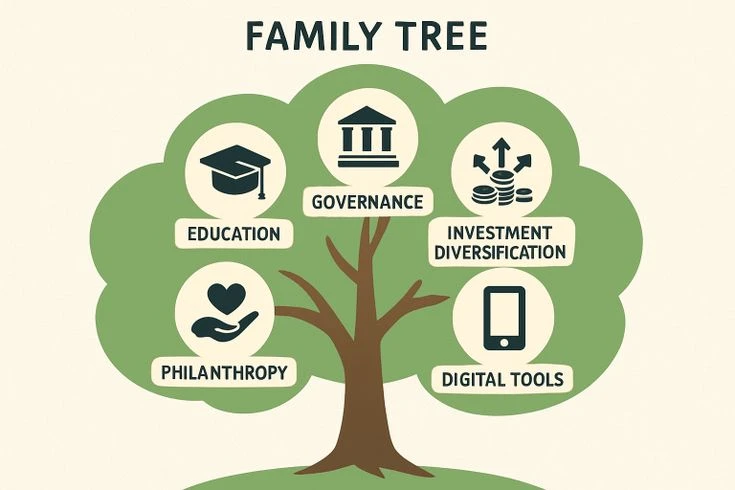
Image on Pinterest
What Is Family Governance?
Family governance is the system a family uses to make decisions together, communicate effectively across generations, resolve conflicts before they escalate, and preserve a shared sense of purpose around accumulated wealth. At its core, family governance provides structure without sacrificing family autonomy, and it establishes clear processes for discussing important financial matters, making collective decisions, and transmitting family culture to every generation that follows.
The term is frequently confused with estate planning, but the two serve completely different functions. Estate planning determines what happens to your assets when you die while family governance determines how your family manages those assets while everyone is still living, and how the next generation is prepared to eventually take over.
A formal family governance structure rests on three interconnected layers.
- The first is a governing document, most commonly a family constitution or family charter.
- The second is a governing body, typically called a family council.
- The third is an ongoing operating process that includes regular family meetings, communication protocols, heir education programs, and a defined investment policy.
When all three layers are functioning and maintained together, family governance becomes the infrastructure through which multigenerational wealth is protected and not just accumulated.
Why Family Governance Fails Without a Deliberate Framework
Most families never plan to lose their wealth, that’s why the founder generation works, sacrifices, makes disciplined decisions, and builds something meaningful. The breakdown consistently happens at the point of generational transfer, when financial responsibilities, unresolved relationships, and competing expectations collide without any agreed-upon structure for managing them.
The numbers make the stakes clear as Cerulli Associates projects that $124 trillion will transfer between generations through 2048, with $105 trillion flowing to heirs across the United States alone. Meanwhile, according to PwC’s 2024 Family Barometer report, transfers to the third generation succeed in only 12% of cases. The pattern is predictable: communication breaks down when no structured forum exists for discussing money, values, and expectations. Heirs fail to take ownership when financial education is never formally built into the family experience, and shared purpose collapses when the next generation inherits assets without understanding what those assets were built for or what responsibilities accompany them.
Family governance directly solves all three failure modes as it creates the forum for structured communication, the educational framework for heir preparation, and the mission-driven document that provides the next generation with the “why” behind the family’s wealth.
At T-Bridge Finance LLC, Dr. Taiwo Akindahunsi works with small business owners, high-income professionals, and diaspora investors who have built meaningful wealth and are now asking how to pass it forward without it becoming a source of division. The answer consistently starts with building a family governance framework before a crisis makes it urgent.
Family Constitution vs. Estate Planning: Two Frameworks That Must Work Together
These two concepts are frequently conflated, and the confusion leaves families with legal protection but no relational structure, or values documents that have no legal backing. Understanding the distinction is foundational to building a complete wealth protection strategy.
A Family Constitution Defines How Your Family Operates Together
A family constitution, sometimes called a family charter or family governance document, is a written agreement that defines how your family manages shared wealth, values, and responsibilities across generations. It covers decision-making protocols, distribution policies, conflict resolution mechanisms, membership criteria (who participates in governance decisions), the family’s shared mission, and the amendment process that keeps the document current as the family grows and evolves.
The family constitution is not a legally binding document in the conventional sense. It derives its authority not from courts but from the shared commitment of the family members who helped create it. This is precisely why a collaborative drafting process, often guided by a neutral governance facilitator, produces more durable results than a document handed down from the founder generation without participation from the heirs who will be expected to honor it. The family constitution complements your estate plan, and it governs the relationships and decisions that your legal documents cannot address.
An Estate Plan Defines What Happens to Your Assets at Death
An estate plan is the collection of legal documents, including your will, revocable or irrevocable trusts, powers of attorney, healthcare directives, and beneficiary designations, that determines how assets are distributed at death and who manages financial and medical decisions during incapacity. It is a legal framework enforced by courts, and it operates within the laws of your state and, in relevant cases, at the federal level.
In the United States, the federal estate tax exemption currently stands at approximately $13.61 million per individual as of 2024, according to IRS guidance on estate and gift taxes, but this figure is scheduled to revert to roughly half that level after 2025 unless Congress takes action. Families with significant assets who have not reviewed their estate plans in light of this potential sunset face real and measurable exposure. T-Bridge Finance LLC integrates estate planning strategy into its broader family governance advisory process to ensure that legal and relational structures reinforce each other rather than operating in parallel without connection.

What Does a Complete Family Governance Structure Include?
A complete family governance structure is built around four core components, each serving a distinct and non-redundant function within the broader framework.
The family constitution is the foundational document, and it captures the family’s mission, values, governance rules, and the principles by which the family will manage its collective affairs. A well-drafted family constitution addresses membership criteria, voting rights and decision-making protocols, distribution and spending policies, dispute resolution procedures, and the amendment process.
The family council is the governing body, and it is composed of representatives from multiple family branches or generations and is responsible for overseeing shared decisions, communicating policies to all family members, coordinating with external advisors and trustees, and ensuring the family constitution is being actively honored. Most family governance advisors recommend quarterly meetings at minimum, with a formal annual session reserved for strategic review and any amendments to the governance document.
The investment policy statement provides the financial governance layer as it documents the family’s agreed-upon investment philosophy, risk tolerance, asset allocation guidelines, and performance benchmarks, and it directly connects the family’s values and long-term goals to the actual portfolio decisions made by their wealth management team.
Heir education is the generational layer that most families underinvest in, and it is the layer most directly responsible for whether the family governance structure survives beyond the generation that built it. Rising-generation members need structured exposure to financial literacy, observer roles in family council meetings, and meaningful participation in family philanthropy decisions before taking on formal governance responsibilities.
T-Bridge Finance LLC, guided by Dr. Taiwo Akindahunsi’s expertise developed over the years serving families across Maryland and the broader diaspora community, helps clients build all four components into a cohesive family governance strategy tailored to their specific structure, complexity, and long-term objectives.
How Much Wealth Do You Need Before Family Governance Becomes Necessary?
This is one of the most common questions families bring to T-Bridge Finance LLC, and the threshold is more accessible than most families expect. Family governance is not an instrument reserved exclusively for families with a formal family office or nine-figure net worth. It scales to fit the family’s actual circumstances and complexity.
Families with $1 million or more in investable assets, families that own a business with multiple potential heirs, or families that have already experienced any level of conflict over financial decisions are all immediate candidates for at least a foundational family governance framework. At this level, governance may consist of a shared mission statement, a basic distribution policy, and a communication protocol for financial decisions, all documented in a simple family charter that can grow in sophistication over time.
As wealth and family complexity increase, so does the governance structure. A family with $10 million in assets may benefit from a formal family council, a comprehensive family constitution, and a coordinated estate and trust strategy that is fully aligned with the governance document. Families in the $30 million and above range often layer in more formal governance bodies, dedicated investment committees, and next-generation mentorship programs built into the family governance framework itself.
The most important point, which Dr. Taiwo Akindahunsi and the T-Bridge Finance LLC team consistently emphasize, is that the right time to build a family governance structure is before it is desperately needed, and not after a conflict has already fractured the relationships that wealth is supposed to protect.

Schedule a Family Governance Conversation with T-Bridge Finance LLC
Family governance is not a project you complete once and file away, it is a living practice that protects what you have built and prepares the people you love to steward it responsibly across every generation that follows. If your family is navigating a first-generation wealth transfer, resolving a conflict over shared assets, or simply taking the proactive step of building a structure before it becomes necessary, a thoughtfully designed family governance framework is the most durable protection you can put in place.
To explore how T-Bridge Finance LLC and Dr. Taiwo Akindahunsi can help your family build a family governance structure tailored to your specific circumstances, schedule a consultation at reach out directly through the firm’s contact page.
About the Author
Maxwell is a financial content strategist at T-Bridge Finance LLC, a financial services firm based in Bowie, Maryland. All articles published on this blog are reviewed by Dr. Taiwo Akindahunsi, licensed financial professional and founder of T-Bridge Finance LLC (Maryland insurance license number(s): 3003617918; NPN: 21565039). T-Bridge Finance LLC holds active insurance licenses and serves families across the United States with life insurance, estate planning, college funding, and tax-advantaged wealth strategies. Schedule a free consultation.
FAQ
1. What is family governance and why does it matter?
Family governance is the structured system through which families make shared decisions, communicate across generations, prepare heirs, and protect accumulated wealth from the relational failures that most commonly destroy it. It matters because research consistently shows that 70% of families lose their wealth by the second generation, and the primary causes are communication breakdown and unprepared heirs rather than investment losses or taxes.
2. Is a family constitution legally binding?
A family constitution is not legally binding in the conventional sense and is not typically enforceable in court. Its authority comes from the collaborative process used to create it and from the shared commitment of all participating family members to honor it. It is designed to complement legally binding documents like wills and trusts, not replace them, and it addresses the relational and operational dimensions of wealth management that legal documents cannot govern.
3. What is the difference between a family charter and a family constitution?
A family charter and a family constitution refer to the same type of family governance document in most practical usage. Some advisors distinguish between them by scope, using “charter” for a shorter, values-focused document and “constitution” for a more comprehensive framework that includes governance bodies, voting structures, and distribution policies. T-Bridge Finance LLC treats the terms interchangeably and tailors the document’s scope to each family’s specific complexity and goals.
4. Can family governance prevent inheritance disputes between siblings?
Family governance significantly reduces the likelihood of inheritance disputes by establishing decision-making protocols, distribution policies, and mediation-first conflict resolution procedures before a crisis forces the issue. Families with pre-established governance structures are measurably more likely to maintain unity across generations, though no document eliminates every possible disagreement. The governance process itself, because it creates a shared forum for difficult conversations, often resolves latent tensions before they become formal disputes.
5. Does family governance only apply to families with a business?
Family governance applies to any family with shared wealth, shared assets, or multigenerational planning goals, regardless of whether a family business exists. The governance need arises from the complexity of shared financial decision-making across generations, and that complexity exists whether the wealth is held in investment portfolios, trusts, real estate, life insurance vehicles, or a combination of all of these. T-Bridge Finance LLC works with families across all of these asset structures to build governance frameworks suited to their specific holdings and goals.
Disclaimer: The information in this article is for educational purposes only and does not constitute financial, legal, or insurance advice. Life insurance and financial products vary by carrier, state of residence, age, health profile, and individual circumstances. Past index performance does not guarantee future results. Cash value illustrations referenced in this article are hypothetical projections and not a guarantee of policy performance. T-Bridge Finance LLC is a licensed financial services firm operating in the United States. Please consult a licensed financial advisor or insurance professional before making any insurance or financial planning decisions. To speak with our team, contact us here.