Image on Pinterest
Critical Illness Insurance Claims: The Payout Process in 2026
Getting a serious diagnosis is disorienting enough without also having to figure out how your critical illness insurance policy actually works. Most people buy critical illness insurance, pay the premium every month, and never think about the claims process again until the day they need it, and that day usually arrives with far less warning than anyone would like.
This guide closes that gap. It explains what critical illness insurance is built to do, how a claim moves from diagnosis to payout, what documentation insurers expect, and how long the process realistically takes in 2026.
RELATED BLOG POST
LONG TERM CARE INSURANCE VS MEDICAID IN 2026 (COSTS, RULES AND SMART STRATEGIES)
EQUITY INDEXED ANNUITIES: 401K ROLLOVER FOR 2026 INCOME
2026 COMPLETE FINANCIAL PLANNING GUIDE (INSURANCE, COLLEGE, ESTATE, TAXES & RETIREMENT)
How Final Expense Insurance Covers Funeral Costs (and Protects Your Family)
How Does Critical Illness Insurance Actually Pay Out After a Diagnosis?
A serious diagnosis changes everything in an afternoon, and the last thing anyone wants to think about in that moment is paperwork. Yet understanding how critical illness insurance turns a diagnosis into money in your account is exactly what makes the weeks that follow easier to manage.
In plain terms, critical illness insurance pays a lump sum directly to you once your insurer confirms that you have been diagnosed with a condition your policy covers, such as cancer, a heart attack, or a stroke, and once you have submitted the required proof of that diagnosis. The payout does not reimburse specific medical bills the way traditional health insurance does. Instead, it arrives as one payment that you can use for rent, childcare, travel to treatment, or anything else your family needs while you focus on recovery.
Most insurers pay within a matter of weeks once every required document has been received, and the process itself follows a fairly consistent pattern across carriers, which this guide walks through in full.
What Is Critical Illness Insurance and How Does a Claim Get Triggered?
Critical illness insurance is a supplemental policy that pays a fixed lump sum when you are diagnosed with a specific condition named in your contract, and it exists alongside your regular health insurance rather than replacing it. A claim gets triggered the moment a licensed physician confirms a covered diagnosis, whether that is invasive cancer, a heart attack, a stroke, kidney failure, or another listed condition, and it stays your responsibility to notify the insurer and begin the paperwork rather than waiting for the insurer to reach out first.
At T-Bridge Finance LLC, we walk clients through this distinction constantly, because confusion between critical illness insurance and standard health coverage is one of the most common reasons people delay filing a claim. Health insurance pays your providers directly and only covers medical costs, but critical illness insurance pays you, and you decide where the money goes.
Dr. Taiwo Akindahunsi, founder of T-Bridge Finance LLC, often points out that this single distinction is the entire reason the product exists, since a lump sum with no restrictions is what lets a family keep the lights on while a paycheck is paused.
How Do You File a Critical Illness Insurance Claim, Step by Step?
Filing a critical illness insurance claim follows roughly the same sequence no matter which carrier holds your policy, and knowing the order in advance saves real time.
First, contact your insurer or your advisor as soon as you have a confirmed diagnosis, since most policies expect notification within a set window after diagnosis rather than an open-ended delay.
Second, request the claim form directly from the insurer or download it from their policyholder portal, and complete the policyholder sections in full so nothing bounces back for a signature you forgot.
Third, have your attending physician complete their portion of the form, which typically requires the physician who diagnosed you rather than a general practitioner, since insurers require an attending physician’s statement along with supporting documentation such as test results, clinical diagnoses, imaging results, operative reports, and pathology reports.
Fourth, gather every supporting record you can access on your own, including pathology reports, surgical notes, lab results, and other clinical records that support the diagnosis, along with the date the diagnosis was verified.
Fifth, submit the completed packet to the insurer, either through an online portal, by mail, or by fax, and keep a copy of everything you send.
Sixth, follow up if you do not hear back within the timeframe your policy states, since a quiet claim is not always a denied claim, it is sometimes just a claim waiting on one missing form.

Image on Pinterest
What Documents Do You Need for a Critical Illness Insurance Claim?
Every insurer asks for some version of the same core packet, and having it ready before you call cuts real time off the process. You need a completed claim form or statement of insured, a physician’s statement completed by the doctor who diagnosed the condition, and the medical evidence behind the diagnosis itself, which usually means pathology reports, lab results, imaging or EKG results, surgical or operative notes, and hospital admission or discharge summaries where applicable.
You also need the specific date the diagnosis was confirmed, since several conditions carry precise diagnostic criteria your insurer will check line by line, and you need a signed authorization allowing the insurer to request additional records directly from your providers if anything is missing.
One detail that surprises people is how strict the definitions can be. A heart attack claim, for example, generally needs to be supported by several specific indicators together, such as characteristic chest pain, new EKG changes, elevated cardiac enzymes, or confirmatory imaging, and a stroke claim generally needs documented neurological deficits confirmed by neuroimaging.
This is not the insurer being difficult for its own sake, it is the policy language doing exactly what it was written to do, and it is also exactly why working with an advisor who understands critical illness insurance definitions before you file can prevent an easily avoidable delay.
How Long Does It Take to Get a Critical Illness Insurance Payout?
Once every required document has reached the insurer, most claims move faster than people expect. Some carriers report processing straightforward claims in about seven business days after all required documentation is submitted, and others cite a similar window of roughly ten business days once all the required information is received, with payment sent by direct deposit or check.
Broader industry estimates put the full range between two and eight weeks, and claims on policies that have been in force for less than a year can take longer, since insurers look more closely at whether a condition may have been present before coverage began.
Two things speed this up more than anything else, and both are within your control. Submitting a complete packet the first time avoids the back-and-forth that adds the most delay, and choosing electronic submission and direct deposit over mailed paper forms shaves days off nearly every carrier’s timeline.
If you are working with T-Bridge Finance LLC on a critical illness insurance claim, part of what a professional does is check your packet against the insurer’s specific documentation checklist before it goes out the door, precisely to avoid a second round of requests.
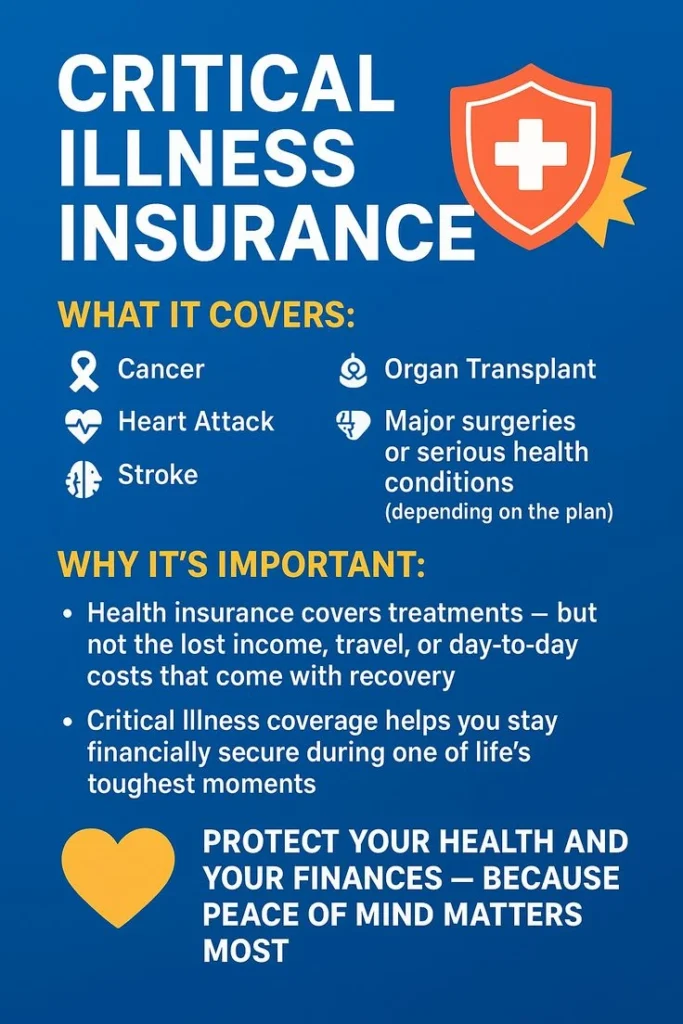
Image on Pinterest
Lump-Sum Critical Illness Payouts vs Traditional Health Insurance Reimbursement
People often assume critical illness insurance and health insurance do the same job with different paperwork, and that assumption causes real confusion at claim time, so it is worth separating the two clearly.
How a Lump-Sum Critical Illness Insurance Payout Works
A critical illness insurance payout arrives as one fixed amount once your diagnosis is confirmed, and the amount is set by your policy rather than by your actual medical bills. You can spend it on the mortgage, on childcare, on travel to a specialist, on lost income while you are out of work, or on anything else, because the money can be used however you like, whether that means daily expenses or costs your regular health plan does not touch. Once the covered condition is paid out, many policies end that coverage, since the benefit was designed as a single financial cushion tied to one qualifying event rather than an ongoing reimbursement account.
How Traditional Health Insurance Reimbursement Works
Health insurance works on a completely different model, since it pays providers directly for covered medical services as they happen, and it continues doing so for the life of the policy rather than ending after one payout. It does not hand you cash, and it does not cover rent, groceries, or income lost while you are unable to work.
Critical illness insurance is not intended to be a substitute for medical coverage that pays for hospital, surgical, and medical expenses, which is exactly why the two products are meant to work together rather than in competition. Health insurance absorbs the treatment cost while critical illness insurance absorbs the disruption to everything else in your life while that treatment happens.
Why Do Critical Illness Insurance Claims Get Denied?
Most denials trace back to a small number of repeatable causes, and knowing them in advance is the best protection you have. A diagnosis that occurs during your policy’s waiting period is one of the most common reasons for denial, since most policies will not pay for a condition diagnosed before that window closes, even if the diagnosis follows shortly after.
A condition that does not meet your policy’s specific definition is another frequent cause, since insurers evaluate the diagnosis against precise medical criteria rather than the general seriousness of the illness.
Missing or incomplete documentation causes denials as well, particularly when a physician’s statement is not signed, not dated, or comes from a provider who is not considered the attending specialist for that condition.
Pre-existing condition disputes and questions about non-disclosure on the original application round out the most common reasons, along with conditions that are explicitly excluded from the policy, such as certain non-invasive cancers or conditions tied to self-harm or illegal activity.
A denial is rarely the final word. Reviewing the denial letter against your actual policy language, gathering any missing medical evidence, and filing a timely appeal resolves a meaningful share of these cases, and this is an area where working with T-Bridge Finance LLC before you file, rather than after a denial arrives, tends to save both time and stress.
Is a Critical Illness Insurance Payout Taxable?
The tax treatment depends entirely on who paid the premiums. If you paid your critical illness insurance premiums yourself with after-tax dollars, the lump sum you receive is generally not taxable income, since benefits you receive under an accident or health insurance policy on which you paid the premiums are excluded from gross income under federal tax rules.
If your employer paid the premiums and did not include that cost in your taxable wages, the payout is generally treated as taxable income when you receive it. This distinction is spelled out in IRS Publication 525, Taxable and Nontaxable Income, and it is worth confirming which category applies to your policy before you assume either way, since the difference can affect how you plan around the payout.
This is general tax information rather than personalized tax advice, and T-Bridge Finance LLC always recommends confirming your specific situation with a qualified tax professional, particularly if your critical illness insurance was purchased through an employer benefits package rather than an individual policy.
How Can You Use a Critical Illness Insurance Payout?
The lump sum has no restrictions attached, which is the entire point of the product, and most people use it across a mix of categories rather than one single purpose. Common uses include covering the health insurance deductible or copays your primary coverage does not absorb, replacing income while you are out of work, keeping up with a mortgage or rent payment, covering childcare or household help during recovery, and paying for travel or lodging tied to specialist treatment.
Consider a hypothetical example. Rebecca, a fictional client in Anne Arundel County, Maryland, is diagnosed with invasive breast cancer at age forty-eight. Her health insurance covers the surgery and chemotherapy, but it does not cover the six weeks of reduced income while she recovers, the added childcare she needs during treatment days, or the gas money for the drive to a specialist two counties over. Her critical illness insurance payout, filed with support from T-Bridge Finance LLC, covers exactly that gap, and it arrives as cash she controls rather than a reimbursement tied to specific receipts.
This is a fictional scenario built to illustrate how the payout functions, not an account of an actual client, and it reflects the kind of gap critical illness insurance is designed to close for families across the country, not only in Maryland.
Ready to Understand Your Own Coverage?
If you already hold a critical illness insurance policy, or you are deciding whether one belongs in your financial plan, schedule a conversation with T-Bridge Finance LLC to review exactly how your coverage would respond to a real diagnosis.
About the Author
Maxwell is a financial content strategist at T-Bridge Finance LLC, a financial services firm based in Bowie, Maryland. All articles published on this blog are reviewed by the licensed professionals at T-Bridge Finance LLC before publication to ensure accuracy and compliance with current insurance and financial guidelines. T-Bridge Finance LLC holds active insurance licenses and serves families across the United States with life insurance, estate planning, college funding, and tax-advantaged wealth strategies. schedule a free consultation.
FAQ
1. How soon after diagnosis should I file a critical illness insurance claim?
File as soon as you have a confirmed diagnosis, ideally within the notification window your policy states, since delaying does not help your claim and can create avoidable questions later.
2. Do I need a lawyer to file a critical illness insurance claim?
No, most claims are filed directly with the insurer or through an advisor, and legal help is typically only necessary if a legitimate claim is denied and you need to appeal.
3. Can critical illness insurance and health insurance both pay out for the same diagnosis?
Yes, the two are designed to work together, since health insurance pays your medical providers while critical illness insurance pays you directly for everything else the diagnosis disrupts.
4. What happens to my critical illness insurance policy after I receive a payout?
Many policies end coverage for that specific condition once the lump sum is paid, though some newer multi-benefit designs allow additional payouts for different, unrelated conditions later, so it is worth checking your specific contract.
5. Is critical illness insurance worth it if I already have good health insurance?
It depends on your income, savings, and how much disruption a serious diagnosis would cause beyond medical bills, and this is a question T-Bridge Finance LLC can walk through with you based on your specific financial picture rather than a generic rule.
Disclaimer: The information in this article is for educational purposes only and does not constitute financial, legal, or insurance advice. Life insurance and financial products vary by carrier, state of residence, age, health profile, and individual circumstances. Past index performance does not guarantee future results. Cash value illustrations referenced in this article are hypothetical projections and not a guarantee of policy performance. T-Bridge Finance LLC is a licensed financial services firm operating in the United States. Please consult a licensed financial advisor or insurance professional before making any insurance or financial planning decisions. To speak with our team, contact us here.