

In 2026 IUL vs term life insurance depends on your goals. Term life insurance gives affordable temporary protection with no cash value. An IUL policy delivers lifelong coverage plus an IUL account that grows tax free with market linked returns and a zero percent floor. Most families pick IUL insurance for protection and wealth building while term life insurance suits short term needs on a tight budget.

Image on Pinterest
Introduction
If you are shopping for life insurance right now, you have probably heard the big debate around IUL vs term life insurance. One side says term life insurance is simple and cheap. The other side swears by the IUL account for lifelong coverage plus real wealth building. Which one actually fits your goals in 2026?
I get it, the choice feels overwhelming, you want solid protection for your family today and smart money growth for tomorrow. In this guide we break everything down in plain English so you can decide with confidence. We will look at real 2025-2026 numbers, the pros and cons of each IUL policy, and even the classic “buy term life insurance and invest the difference” strategy.
Ready to see what an IUL policy or term life insurance quote looks like for your exact situation? Consult T.bridge finance to book a free 15 minute strategy call with our team. We will run real illustrations side by side so you can choose with total confidence.
What is IUL and how does it differ from term life insurance?
An IUL is indexed universal life insurance. It gives you lifelong coverage and an IUL account that grows based on stock market indexes like the S&P 500. Your IUL policy has a floor rate of zero percent so your cash value never drops when markets fall. Term life insurance, on the other hand, covers you for a set number of years, usually 10 to 30, and has no cash value at all.
Most people choose IUL when they want both protection and a place to build tax deferred wealth inside the IUL insurance. Term life insurance works great when you need big coverage now while your kids are young and your mortgage is high.
How much more expensive is IUL than term life insurance in 2026?
Term life insurance stays the clear winner on price for pure protection. A healthy 40 year old can buy one million dollars of 20 year term life insurance for roughly 500 to 1,500 dollars per year. The same coverage in an IUL policy often starts at 8,000 to 15,000 dollars annually for a 40 year old business owner.
That gap looks huge at first. But remember the IUL policy builds cash value you can access later through tax free loans. Over 20 years the extra premium paid into the IUL account can turn into a sizable asset while your term life insurance simply ends.
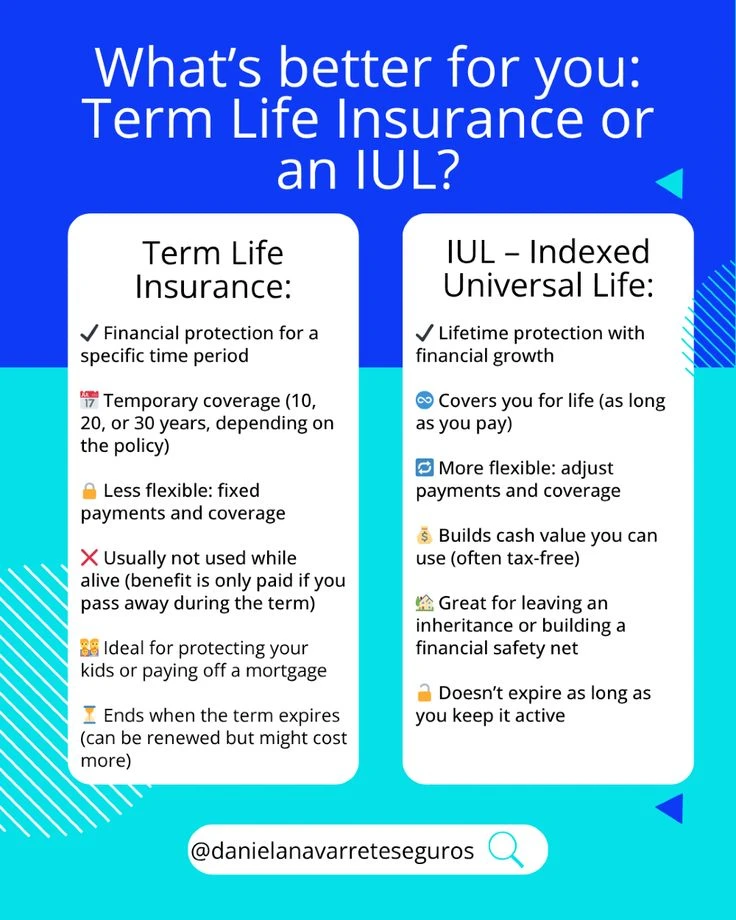
Image on Pinterest
Does an IUL really build wealth better than buying term life insurance and investing the difference?
This is the question everyone asks. The classic advice is to buy cheap term life insurance and invest the premium difference in the stock market yourself. In many cases that strategy works if you stay disciplined.
Yet recent 2025 LIMRA data shows IUL new premiums hit 4.5 billion dollars and captured 25 percent of the entire U.S. life insurance market. Why? Because the IUL account offers tax free growth, tax free loans, and a zero percent floor that protects your principal. You do not get that downside protection when you invest the difference in a taxable brokerage account.
Current 2026 IUL cap rates sit between 8.5 percent and 12.25 percent depending on the carrier. Add the guaranteed floor and many families see steadier long term results inside their IUL policy than they would chasing market returns on their own.
What are the real risks and guarantees inside an IUL policy?
Every IUL insurance product carries two main risks.
- First, if the index performs poorly for several years the cash value growth slows.
- Second, if you underfund the policy the cost of insurance can rise and cause the IUL policy to lapse.
The good news? Most Index Universal Life Insurance policies come with a zero percent floor so you never lose cash value from market drops. Carriers also publish current cap rates every year. In 2026 you will still find strong options with 10 to 12 percent caps and 100 percent participation rates on many strategies.
Compare that to term life insurance. The only risk is that your term ends and you must requalify later at much higher rates or go without coverage.
When does term life insurance make more sense than an IUL?
Term life insurance shines when your budget is tight and your need is temporary. Young families with big mortgages and growing kids often pick term life insurance because it delivers maximum death benefit for the lowest premium.
If you only need coverage for the next 15 or 20 years and you already max out your 401k and Roth IRA, then term life insurance plus separate investments can be the smarter move. Many people simply do not want the complexity of managing an Index Universal Life Insurance account.
Can you combine both an IUL policy and term life insurance for maximum protection and wealth?
Yes, and this hybrid approach is gaining popularity in 2026. Some families buy a smaller Index Universal Life Insurance policy for lifetime coverage and cash value growth while layering on a larger term life insurance policy for extra protection during peak earning years.
When the term life insurance ends you can convert it or simply rely on the growing an Index Universal Life Insurance account. This strategy gives you the best of both worlds without stretching your monthly budget too far.

Image on Pinterest
How do living benefits riders fit into your IUL vs term life insurance decision?
Many modern Index Universal Life Insurance policies now include living benefits riders that let you access part of the death benefit early for chronic illness, critical illness, or long term care. These riders add real flexibility that plain term life insurance rarely offers.
If health concerns run in your family, the Index Universal Life Insurance insurance route with built in living benefits can become a powerful safety net.
Conclusion
Choosing between Index Universal Life Insurance vs term life insurance comes down to your timeline, budget, and goals for protection and wealth building. Term life insurance gives you affordable coverage right now. An IUL policy delivers lifelong security plus an IUL account that can grow into real wealth you control tax free.
Whichever path you pick, the important step is taking action today. Your family deserves the peace of mind that comes with the right coverage.
Ready to see what an Index Universal Life Insurance policy or term life insurance quote looks like for your exact situation? Consult T.bridge finance to book a free 15 minute strategy call with our team. We will run real illustrations side by side so you can choose with total confidence.
FAQs
1. Is an Index Universal Life Insurance policy worth it in 2026?
Yes for people who want lifelong coverage plus tax free cash value growth. If you prefer low cost temporary protection then term life insurance is still the better fit.
2. Can my Index Universal Life Insurance account lose money?
No. The zero percent floor protects your cash value from market losses even when the S&P 500 drops.
3. Should I get an Index Universal Life Insurance or stick with term life insurance if I am 45?
At 45 you still have time for the Index Universal Life Insurance account to grow. Run the numbers with a licensed advisor, but many 45 year olds now choose IUL for the wealth building potential.


Pingback: How Final Expense Insurance Covers Funeral Costs (and Protects Your Family) - T-Bridge Finance LLC