
Image on Pinterest
If you have a family member with a disability who relies on Medicaid or Supplemental Security Income, leaving money directly to that person in your will could eliminate those benefits entirely before your family even processes the grief of losing you. A special needs trust solves this problem, and it is a legal arrangement that holds assets for a disabled beneficiary without counting those assets toward Medicaid or SSI eligibility limits, so your loved one receives the financial support you intend for them while keeping the government benefits they depend on every day.
This guide explains how a special needs trust works, why the type of trust you choose changes everything, what the trust can and cannot pay for under current law, and how T-Bridge Finance LLC helps families across Maryland and Anne Arundel County structure the right solution before an inheritance creates a crisis rather than a legacy.
Related BlogPost
PROTECT BLACK WEALTH: PUT YOUR MD HOME IN A TRUST NOW
DAD DOES NOT HAVE A WILL? FATHER’S DAY 2026 IS THE IMPORTANT TIME TO FIX IT
DISABLED? MORTGAGE PROTECTION INSURANCE CAN KEEP YOUR FAMILY IN THEIR HOME
PROTECT WHAT MATTERS MOST: JOINT TENANCY FOR MARRIED COUPLES IN MARYLAND
What Is a Special Needs Trust?
A special needs trust, sometimes called a supplemental needs trust is a specific type of irrevocable trust designed to hold financial assets for a person with a disability without disqualifying that person from means-tested government programs such as Medicaid and Supplemental Security Income (SSI). The trust does not belong to the beneficiary in the way a personal bank account does. A trustee manages the funds on the beneficiary’s behalf, which is precisely why those funds are not counted as the beneficiary’s personal assets when the government calculates eligibility.
Under federal law, SSI recipients are generally limited to $2,000 in countable assets as a single individual, a threshold established under 42 U.S.C. § 1396p that has not been meaningfully adjusted in decades. Medicaid carries similar financial eligibility requirements at the state level, and Maryland is no exception. Assets held inside a properly drafted special needs trust are excluded from that calculation entirely, which means a person with a disability can receive meaningful financial support without crossing the line that ends their benefits.
T-Bridge Finance LLC works with families across Maryland and Anne Arundel County to structure special needs trust arrangements as part of a comprehensive estate and trust planning process, ensuring the document complies with both federal law and Maryland’s specific Medicaid requirements from the day it is signed.

Image on Pinterest
Why Leaving Money Directly to a Disabled Family Member Can Eliminate Their Benefits
Most families do not realize this until it is too late. A parent writes a will that names their adult child with Down syndrome as a direct beneficiary of $90,000. The parent passes away, the estate settles, and the inheritance is transferred to the child’s personal account. Within thirty days, SSI is suspended and Medicaid eligibility is terminated, because the child now holds assets far above the $2,000 limit.
The child is not disqualified permanently, but they are required to spend down the inherited funds until their assets fall below the eligibility threshold again. In practice, this means paying privately for the medical care, prescriptions, and home health services that Medicaid had been covering, which can cost tens of thousands of dollars per year. A $90,000 inheritance can disappear within eighteen months, and the family’s intended legacy becomes a temporary gap in a safety net that should never have been interrupted.
A special needs trust prevents this scenario entirely. The inheritance passes into the trust rather than directly to the beneficiary, the beneficiary’s countable assets remain below the eligibility limit, and Medicaid and SSI continue without interruption. The money does exactly what the parent intended it to do: it improves the quality of the beneficiary’s life in ways that government programs simply do not cover.
The Medicaid Asset Trap: What Maryland Families Need to Understand
Maryland’s Medicaid program, administered by the Maryland Department of Health, follows federal asset limits and has its own estate recovery provisions, which means the planning stakes in this state are particularly high. Maryland currently pursues Medicaid estate recovery, a process by which the state seeks reimbursement from a deceased Medicaid recipient’s estate for the cost of benefits provided during their lifetime. This estate recovery process interacts directly with how a special needs trust is structured, and the type of trust you choose determines whether your family’s assets are protected after the beneficiary passes away.
In our experience working with families in Maryland and Anne Arundel County, the most common mistake is not the failure to create a special needs trust at all, it is creating the wrong type of trust, or creating one without understanding the Medicaid payback clause and what it means for the family’s long-term wealth. Dr. Taiwo Akindahunsi and the team at T-Bridge Finance LLC address this distinction directly in every trust planning engagement, because the difference between the two trust types is not technical, it is financial and deeply personal.
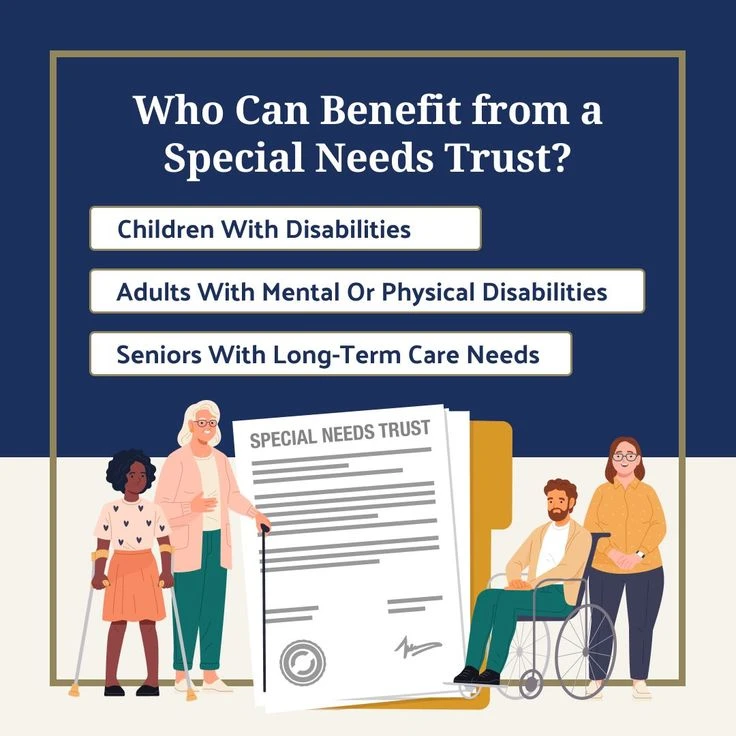
Image on Pinterest
First-Party Special Needs Trust vs. Third-Party Special Needs Trust
The two most important words in special needs trust planning are “first-party” and “third-party,” and understanding the difference between them determines both the planning strategy and the outcome for your family.
First-Party Special Needs Trust: When the Money Belongs to the Beneficiary
A first-party special needs trust is funded with money that already legally belongs to the disabled person. The most common scenarios are a personal injury lawsuit settlement, an unplanned direct inheritance where the beneficiary was named individually in a will, or a gift that was mistakenly transferred into the beneficiary’s personal account. Because the money originated with the beneficiary, federal law requires that the trust include a Medicaid payback clause, codified under 42 U.S.C. § 1396p(d)(4)(A).
When the beneficiary dies, any funds remaining in the trust must first be used to reimburse the state Medicaid program for benefits paid during the beneficiary’s lifetime, before any money can pass to heirs. There is an additional restriction: a first-party special needs trust can only be established for a beneficiary who is under the age of 65 at the time of creation. For families in reactive situations, this trust is the tool that preserves benefits when the inheritance has already arrived and cannot be redirected.
Third-Party Special Needs Trust: The Proactive Choice for Estate Planning
A third-party special needs trust is funded with money that never belonged to the beneficiary. Parents, grandparents, aunts, uncles, and other relatives contribute their own funds to this trust for the benefit of a family member with a disability. Because the assets were never the property of the beneficiary, Medicaid has no legal claim to them after the beneficiary’s death. There is no payback provision. When the beneficiary passes away, whatever assets remain in the trust pass to whoever the trust creator designates, whether that is other children, a charity, or a family foundation.
There is also no age restriction for the beneficiary with a third-party trust, which makes it suitable for planning at any stage of life. For families doing proactive estate planning, including parents who want to ensure their disabled child is cared for after they are gone, the third-party special needs trust is almost always the right choice, and T-Bridge Finance LLC helps Maryland families establish these structures as part of a complete estate planning engagement.
The emotional weight of the Medicaid payback clause in a first-party trust is something Dr. Taiwo Akindahunsi addresses plainly with every client who asks about it. The government’s position is that if a person used their own money to qualify for a public benefit program during their lifetime, the state has a right to partial reimbursement at death. The third-party trust eliminates this dynamic entirely, which is why proactive planning; done before any inheritance or gift changes hands, protects both the beneficiary and the family’s broader legacy in a way that reactive planning cannot.
What Can a Special Needs Trust Pay For?
This is the question trustees ask most often, and the answer is more generous than most families expect, particularly after a significant rule change that took effect in September 2024. A special needs trust can pay for education, therapy and rehabilitation services not covered by Medicaid, transportation and vehicle-related expenses, technology including computers and smartphones, recreational activities and travel, personal care items, clothing, home modifications, uncovered dental and medical costs, legal fees, and professional services. The trustee makes these payments directly to vendors, service providers, or educational institutions rather than distributing cash to the beneficiary.
As of September 30, 2024, the Social Security Administration issued a final rule under 89 FR 22003 that removed food from the definition of in-kind support and maintenance for SSI purposes. For years before this change, a special needs trust could pay for a beneficiary’s vacation, electronics, or therapy, but paying for groceries could trigger an SSI reduction, but that restriction no longer applies. Food can now be paid from a special needs trust without any impact on the beneficiary’s SSI payment.
Housing costs remain a more sensitive category. If a special needs trust pays for rent, mortgage payments, or utilities directly to a landlord or utility provider, SSA may treat that payment as in-kind support and maintenance under its shelter rules, which can reduce the monthly SSI benefit by up to approximately $331 per month in 2026, according to SSA’s current ISM guidelines.
What Can a Special Needs Trust Not Pay For?
The one rule that overrides everything else is the prohibition on direct cash payments to the beneficiary. If the trustee distributes cash directly to the beneficiary, SSI is reduced dollar-for-dollar up to the full monthly benefit. A single $500 cash payment to a beneficiary receiving the 2026 federal SSI rate of $994 per month can immediately reduce that payment by $500, and a larger cash distribution can eliminate the benefit entirely for that month. Prepaid gift cards and other cash equivalents carry the same consequence.
The trust also cannot pay for services or goods already covered under the beneficiary’s Medicaid plan. Paying for Medicaid-covered services out of the trust wastes trust assets on something the government was already providing, and it does not expand the beneficiary’s care in any meaningful way.
Finally, distributions that primarily benefit someone other than the trust beneficiary are not permitted under the trust’s governing terms. The trust exists for one purpose, which is the supplemental benefit of the named individual with a disability, and every distribution decision must be evaluated through that lens.
Recent Changes to Special Needs Trust Rules in 2024, 2025, and 2026
Families who established a special needs trust before 2024 should be aware that several significant changes have occurred that may affect how their trust operates today. The food ISM change discussed above is the most broadly applicable update for trustees. The annual contribution limit for ABLE accounts increased to $20,000 for 2026, and the ABLE Age Adjustment Act raised the disability onset age from 26 to 46, expanding eligibility significantly for adults who were previously excluded. ABLE accounts can be coordinated strategically with a special needs trust, a topic addressed below.
At the legislative level, the Stop Unfair Medicaid Recoveries Act, introduced in January 2026, seeks to eliminate the federal requirement that states recover Medicaid costs from deceased recipients’ estates. If enacted, this reform would remove the rationale for the payback clause in first-party trusts. As of June 2026, this legislation has not been enacted, and all planning decisions at T-Bridge Finance LLC are made under current law. Families should continue planning under existing Medicaid estate recovery rules while staying informed about legislative developments that could meaningfully change the landscape.
The SSI Savings Penalty Elimination Act, reintroduced in April 2025 with bipartisan support, would raise the individual SSI asset limit from $2,000 to $10,000 if passed. This bill has not been enacted, and the $2,000 limit remains in effect. Planning under the existing threshold remains the responsible approach.
How to Set Up a Special Needs Trust in Maryland
The process of establishing a special needs trust in Maryland follows a defined sequence, and each step has consequences for the trust’s validity and the beneficiary’s continued eligibility for government benefits.
The first step is identifying which type of trust is appropriate given the family’s circumstances, the source of the funds, and the age of the beneficiary. The second step is engaging an attorney or financial planning firm with direct experience in disability law and Medicaid compliance, because a generic trust template purchased online carries a meaningful risk of containing defective language that renders the trust non-compliant. Maryland has specific Medicaid rules, and the Maryland Department of Health reviews first-party trusts for compliance before they are accepted.
The third step is selecting a trustee, a decision that carries long-term implications for the beneficiary’s care quality and the family’s peace of mind. The fourth step is drafting and executing the trust document with precision, after which the trust must be funded by transferring assets into it. The fifth step is updating existing wills, beneficiary designations on life insurance policies, and retirement account designations to ensure that all assets intended for the disabled family member flow into the trust rather than directly to the individual.
T-Bridge Finance LLC guides Maryland families through each stage of this process, coordinating with estate planning attorneys where needed and ensuring that the financial structure around the trust, including life insurance, annuities, and portfolio assets, aligns with the beneficiary’s long-term needs and the family’s broader goals.
Who Should Be the Trustee of a Special Needs Trust?
The trustee of a special needs trust carries significant responsibility. That person or institution must manage distributions in compliance with SSI and Medicaid rules, keep detailed records of every transaction, file any required reports with state agencies, and make judgment calls about what the beneficiary needs that falls within the trust’s permitted categories. The trustee’s decisions directly affect the beneficiary’s quality of life and their continued eligibility for government benefits.
Families generally consider three options. A family member trustee, typically a sibling or close relative, brings personal knowledge of the beneficiary’s needs and typically charges no management fee. The risk is that family trustees may lack technical compliance knowledge, which can lead to inadvertent distributions that jeopardize benefits. A professional trustee such as a trust attorney, a CPA, or a bank trust department brings regulatory expertise and institutional continuity, particularly important when the question is who manages the trust after the parents themselves have passed away.
Corporate or institutional trustees typically charge annual fees ranging from 0.75 to 1.5 percent of assets under management. A pooled trust administered by a nonprofit organization is a third option, particularly suitable when trust assets are modest, because the pooled structure makes professional management economically viable.
ABLE Accounts and Special Needs Trusts: A Coordinated Strategy
An ABLE account is a tax-advantaged savings account available to individuals whose disability began before age 46, a threshold raised in 2026 from the previous age 26 limit. ABLE accounts allow contributions of up to $20,000 per year in 2026 from any source, including from the special needs trust itself. The first $100,000 held in an ABLE account does not count toward SSI’s $2,000 asset limit, and ABLE accounts carry no Medicaid payback requirement on third-party contributions.
The most efficient strategy for many Maryland families is to use a special needs trust to hold larger assets and long-term funds while using an ABLE account for day-to-day disability-related expenses, because ABLE accounts allow the beneficiary more direct access to funds for qualified expenses without the same trustee distribution process.
A special needs trust can fund an ABLE account, which creates a coordinated, two-tier structure. Families whose trusts were drafted before ABLE accounts were widely available should have an attorney review the trust language to confirm it includes authorization for the trustee to fund an ABLE account. Many older trust documents do not include this provision, and a simple amendment can open this planning opportunity.
Why You Need Special Needs Trust Conversation This Summer
Summer is when families gather, when the conversations that have been deferred for months finally have a natural opening. For any family with a disabled member who depends on Medicaid, the most important question to raise around the table this season is whether your current will and estate plan would inadvertently terminate that person’s benefits the moment you are no longer here.
The questions worth asking are direct and practical. Does your existing will name the disabled family member as a direct beneficiary, rather than naming a special needs trust for their benefit? Does any life insurance policy list the disabled individual as a direct beneficiary? Has your family agreed on who would serve as trustee? These questions take less than an hour to answer with the right guidance, and the cost of not asking them can be the complete elimination of the benefits your family member relies on for daily survival.
T-Bridge Finance LLC makes this conversation accessible for Maryland families, including diaspora families navigating cross-border estate planning questions specific to the Anne Arundel County and greater Maryland market. Dr. Taiwo Akindahunsi has seen firsthand how a single planning session in June can prevent a financial crisis in December, and the firm’s trust services are designed to move families from awareness to action within a clear, manageable timeline.
Protect Your Loved One’s Benefits Before Summer Ends
If your family has a member with a disability who relies on Medicaid or SSI, and your current will or estate plan does not include a properly structured special needs trust, your most important financial planning move this summer is to address that gap before it becomes a crisis. The difference between a direct inheritance and a trust-directed one can mean the difference between a disabled family member keeping the care they depend on and losing it permanently.
T-Bridge Finance LLC serves families across Maryland and Anne Arundel County with trust planning services designed specifically for this situation. Dr. Taiwo Akindahunsi and the team bring direct experience in estate and trust planning for Maryland residents, including families navigating complex multi-generational and diaspora wealth considerations.
Schedule a complimentary planning consultation today and take the one step this summer that protects your loved one’s quality of life for every year after you are gone.
About the Author
Maxwell is a financial content strategist at T-Bridge Finance LLC, a financial services firm based in Bowie, Maryland. All articles published on this blog are reviewed by the licensed PROFESSIONALS at T-Bridge Finance LLC before publication to ensure accuracy and compliance with current insurance and financial guidelines. T-Bridge Finance LLC holds active insurance licenses and serves families across the United States with life insurance, estate planning, college funding, and tax-advantaged wealth strategies. schedule a free consultation.
FAQ
1. What is a special needs trust, and why do disabled people need one?
A special needs trust is a legal arrangement that holds assets for a person with a disability without counting those assets toward their Medicaid or SSI eligibility. Medicaid and SSI limit recipients to $2,000 in countable assets, so without a trust, any inheritance or gift received directly by the beneficiary can immediately disqualify them from benefits they depend on for medical care, prescriptions, and daily support services.
2. What is the difference between a first-party and a third-party special needs trust?
A first-party special needs trust is funded with the disabled person’s own money, such as a settlement or an unplanned inheritance, and it must include a Medicaid payback clause at death. A third-party special needs trust is funded by a parent, grandparent, or other family member with their own money, it has no Medicaid payback requirement, and remaining assets can pass freely to heirs after the beneficiary’s death. Most families doing proactive estate planning use the third-party structure because it protects the family’s wealth more completely.
3. Does a special needs trust have to pay back Medicaid when the beneficiary dies?
It depends on the trust type. A first-party special needs trust must reimburse the state Medicaid program from any remaining assets when the beneficiary dies, as required by federal law under 42 U.S.C. § 1396p(d)(4)(A). A third-party special needs trust has no Medicaid payback obligation, and whatever remains in the trust at the beneficiary’s death passes to designated heirs or beneficiaries without any state claim.
4. What can a special needs trust pay for without affecting SSI and Medicaid?
A special needs trust can pay for education, therapy, transportation, technology, recreation, clothing, personal care items, and uncovered medical and dental expenses without reducing SSI or Medicaid benefits. As of September 30, 2024, food can also be paid from the trust without triggering an SSI reduction, following a rule change by the Social Security Administration under Final Rule 89 FR 22003. The trust should not distribute direct cash to the beneficiary, because cash payments reduce SSI dollar-for-dollar.
5. Can I set up a special needs trust in my will in Maryland?
Yes. A testamentary special needs trust is created within your will and takes effect at your death. It is a common tool for Maryland parents who want to ensure a disabled child is provided for after they are gone. However, because a testamentary special needs trust only activates at death, it cannot hold assets during your lifetime or protect against benefit disruptions that occur before you pass away. A standalone living trust offers more flexibility, and T-Bridge Finance LLC can guide Maryland families through both options as part of a comprehensive estate planning conversation.
Disclaimer: The information in this article is for educational purposes only and does not constitute financial, legal, or insurance advice. Life insurance and financial products vary by carrier, state of residence, age, health profile, and individual circumstances. Past index performance does not guarantee future results. Cash value illustrations referenced in this article are hypothetical projections and not a guarantee of policy performance. T-Bridge Finance LLC is a licensed financial services firm operating in the United States. Please consult a licensed financial advisor or insurance professional before making any insurance or financial planning decisions. To speak with our team, contact us here.